Some interesting facts about the Human Body

Human body is the Protective part of our Soul, let us see some of the Crazy and interesting facts about our Human Body which is unknown to you so far.


1) The Acids in stomach are very strong, it can Dissolve Zinc.The cells in the Stomach lining will renew so
    fast, so fortunately it had no time to dissolve it

2) The Tiny Blood Vessels of Lungs was over 300,000 million, if it is laid end to end they can stretch about
     2400 kilometers

3) The Testicles of Man can manufacture 10 million new sperm cells each day

4) About 1 Million individual Filters are there in the Kidneys, which around 1.3 Liters of Blood per minute
    and expel up to 1.4 liters of Urine a Day are filtered by the kidneys

5) About 90% of the information are Receiving by our Eyes,which makes us Visually Creatures a lot

6) The Female Ovaries contain a Half Million Egg cells but yet about 400 will get the opportunity to create a
    New life

7) From Growing Base to Tip, the Finger and toenail takes of Six Months

8) The Person in the West Eats about 50 tonnes of Food and drink 50,000 Liters of water in his lifetime

9) In the Time period of 30 Minutes the Body gains enough Heat to Boil an half gallon of Water.

10) It takes about 60 Seconds for an Single Human blood cell to make a Complete circuit of our Body

Strange Facts


Bone is five times stronger than steel.
Alexander Graham Bell, the inventor of the telephone, never telephoned His wife or mother because they were both deaf.
Bamboo can grow up to 3 ft in 24 hours.
111,111,111 x 111,111,111 = 12,345,678,987,654,321
“Bookkeeper” is the only word in English language with three consecutive Double letters.
Sharks can live up to 100 years.
When glass breaks, the cracks move at speeds of up to 3,000 miles per hour.
All the planets in our solar system rotate anticlockwise, except Venus. It is the only planet that rotates clockwise.
Cockroach is the fastest animal on 6 legs covering a meter a second.
Due to gravitational effects, your weigh slightly less when the moon is directly overhead.
Polar Bear can look clumsy & slow but during chase on ice, can reach 25 miles / hr of speed.
The only 2 animals that can see behind itself without turning it’s head are the rabbit and the parrot.
Our eyes are always the same size from birth, but our nose and ears never stop growing.
The Statue of Liberty’s index finger is eight feet and one inch long.
Giraffes can not swim.

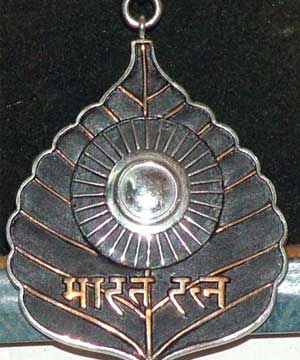
Bharat Ratna

Bharat Ratna is the Republic of India’s highest civilian award, awarded for the highest degrees of national service. This service includes artistic, literary, and scientific achievements, as well as “recognition of public  service of the highest order. Unlike knights, holders of the Bharat Ratna carry no special title nor any other honorifics, but they do have a place in the Indian order of precedence.
The award was established by the first President of India, Rajendra Prasad, on 2 January 1954. Along with other major national honours, such as the Padma Vibhushan, Padma Bhushan and Padma Shri.
Complete list of recipients
Name:Chakravarti Rajagopalachari(1878–1972)
Year Awarded:1954
Note: Independence activist, last Governor-General
Name:C. V. Raman(1888–1970)
Year Awarded:1954
Note: Physicist
Name:Sarvepalli Radhakrishnan(1888–1975)
Year Awarded:1954
Note: Philosopher, second President
Name:Bhagwan Das(1869–1958)
Year Awarded:1955
Note: Independence activist, author
Name:Mokshagundam Visvesvarayya(1860–1962)
Year Awarded:1955
Note: Civil engineer, Diwan of Mysore
Name:Jawaharlal Nehru(1889–1964)
Year Awarded:1955
Note: Independence activist, author, first Prime Minister
Name:Govind Ballabh Pant(1887–1961)
Year Awarded:1957
Note: Independence activist, Chief Minister of Uttar Pradesh, Home Minister
Name:Dhondo Keshav Karve(1858–1962)
Year Awarded:1958
Note: Educator, social reformer
Name:Bidhan Chandra Roy(1882–1962)
Year Awarded:1961
Note: Physician, Chief Minister of West Bengal
Name:Purushottam Das Tandon(1882–1962)
Year Awarded:1961
Note: Independence activist, educator
Name:Rajendra Prasad(1884–1963)
Year Awarded:1962
Note: Independence activist, jurist, first President
Name:Zakir Hussain(1897–1969)
Year Awarded:1963
Note: Scholar, third President
Name:Pandurang Vaman Kane(1880–1972)
Year Awarded:1963
Note: Indologist and Sanskrit scholar
Name:Lal Bahadur Shastri(1904–1966)
Year Awarded:1966
Note: Posthumous, independence activist, second Prime Minister
Name:Indira Gandhi(1917–1984Y
ear Awarded:1971
Note: Fourth Prime Minister
Name:V. V. Giri(1894–1980)
Year Awarded:1975
Note: Trade unionist and fourth President
Name:K. Kamaraj(1903–1975)
Year Awarded:1976
Note: Posthumous, independence activist, Chief Minister of Madras State
Name:Mother Teresa(1910–1997)
Year Awarded:1980
Note: Catholic nun, founder of the Missionaries of Charity
Name:Vinoba Bhave(1895–1982)
Year Awarded:1983
Note: Posthumous, social reformer, independence activist
Name:Khan Abdul Ghaffar Khan(1890–1988)
Year Awarded:1987
Note: First non-citizen, independence activist
Name:M. G. Ramachandran(1917–1987)
Year Awarded:1988
Note: Posthumous, film actor, Chief Minister of Tamil Nadu
Name:B. R. Ambedkar(1891–1956)
Year Awarded:1990
Note: Posthumous, chief architect of the Indian Constitution, politician, economist, and scholar
Name:Nelson Mandela(b. 1918)
Year Awarded:1990
Note: Second non-citizen and first non-Indian recipient, Leader of the Anti-Apartheid movement
Name:Rajiv Gandhi(1944–1991)
Year Awarded:1991
Note: Posthumous, Seventh Prime Minister
Name:Vallabhbhai Patel(1875–1950)
Year Awarded:1991
Note: Posthumous, independence activist, first Home Minister
Name:Morarji Desai(1896–1995)
Year Awarded:1991
Note: Independence activist, fifth Prime Minister
Name:Abul Kalam Azad(1888–1958)
Year Awarded:1992
Note: Posthumous, independence activist, first Minister of Education
Name:J. R. D. Tata(1904–1993)
Year Awarded:1992
Note: Industrialist and philanthropist
Name:Satyajit Ray(1922-1992)
Year Awarded:1992
Note: Bengali filmmaker
Name:A. P. J. Abdul Kalam(b. 1931)
Year Awarded:1997
Note: Aeronautical Engineer,11th President of India
Name:Gulzarilal Nanda(1898–1998)
Year Awarded:1997
Note: Independence activist, interim Prime Minister
Name: Aruna Asaf Ali(1908–1996)
Year Awarded:1997
Note: Posthumous, independence activist
Name: M. S. Subbulakshmi(1916–2004)
Year Awarded:1998
Note: Classical Carnatic singer
Name: Chidambaram Subramaniam(1910–2000)
Year Awarded:1998
Note: Independence activist, Minister of Agriculture
Name: Jayaprakash Narayan(1902–1979)
Year Awarded:1999
Note: Posthumous, independence activist and politician
Name: Ravi Shankar(b. 1920)
Year Awarded:1999
Note: Sitar player
Name: Amartya Sen(b. 1933)
Year Awarded:1999
Note: Economist
Name: Gopinath Bordoloi(1890–1950)
Year Awarded:1999
Note: Posthumous, independence activist, Chief Minister of Assam
Name: Lata Mangeshkar(b. 1929)
Year Awarded:2001
Note: Playback singer
Name: Bismillah Khan(1916–2006)
Year Awarded:2001
Note: Hindustani classical shehnai player
Name: Bhimsen Joshi(1922-2011)
Year Awarded:2008
Note: Hindustani classical singer

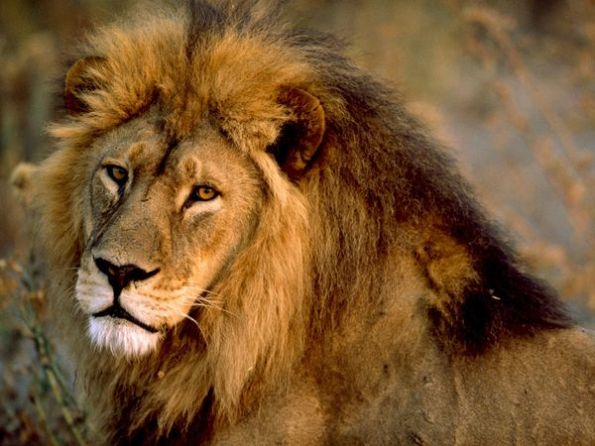
Lion

The lion (Panthera leo) is one of the four big cats in the genus Panthera, and a member of the family Felidae.

With some males exceeding 250 kg (550 lb) in weight, it is the second-largest living cat after the tiger.
Wild lions currently exist in Sub-Saharan Africa and in Asia with an endangered remnant population in Gir Forest National Park  in India, having disappeared from North Africa and Southwest Asia in historic times.
About 10,000 years ago, the lion was the most widespread large land mammal after humans.
They were found in most of Africa, across Eurasia from western Europe to India, and in the Americas from the Yukon to Peru.
The lion is a vulnerable species, having seen a possibly irreversible population decline of thirty to fifty percent over the past  two decades in its African range.
Lion populations are untenable outside designated reserves and national parks.
Although the cause of the decline is not fully understood, habitat loss and conflicts with humans are currently the greatest  causes of concern.
Lions live for ten to fourteen years in the wild, while in captivity they can live longer than twenty years.
In the wild, males seldom live longer than ten years, as injuries sustained from continual fighting with rival males greatly  reduce their longevity.
Lions are unusually social compared to other cats.
A pride of lions consists of related females and offspring and a small number of adult males.
Groups of female lions typically hunt together, preying mostly on large ungulates.
Highly distinctive, the male lion is easily recognised by its mane, and its face is one of the most widely recognised animal  symbols in human culture.

Red Fort

The Red Fort is a 17th century fort complex constructed by the Mughal emperor Shah Jahan in the walled city of Old Delhi (in  present day Delhi, India) that served as the residence of the Imperial Family of India. It also served as the capital of the  Mughals until 1857, when Mughal emperor Bahadur Shah Zafar was exiled by the British Indian government.
Mughal Emperor Shah Jahan, started construction of the massive fort in 1638 and work was completed in 1648 (10 years).  The Red Fort was originally referred to as “Qila-i-Mubarak” (the blessed fort). The layout of the Red Fort was organised to retain and integrate this site with the Salimgarh Fort. The fortress palace  was an important focal point of the medieval city of Shahjahanabad.
The significant phases of development were under Aurangzeb and  later Mughal rulers. Important physical changes were carried out in the overall settings of the site after the Indian Mutiny in  1857. During the  British period the Fort was mainly used as a cantonment and even after Independence, a significant part of the Fort remained  under the control of the Indian Army until the year 2003.
The Red Fort was the palace for Mughal Emperor Shah Jahan’s new capital, Shahjahanabad (present day Old Delhi). He moved his capital here from Agra in a move designed to bring prestige to his reign, and to  provide ample opportunity to apply his ambitious building schemes and interests.
The fort lies along the Yamuna River, which fed the moats that surround most of the wall. The wall at its north-eastern corner  is adjacent to an older fort, the Salimgarh Fort, a defence built by Islam Shah Suri in 1546.
On 11 March 1783, Sikhs briefly entered Red Fort in Delhi and occupied the Diwan-i-Am.  The city was essentially surrendered by the Mughal wazir in cahoots with his Sikh Allies.
The last Mughal emperor to occupy the fort was Bahadur Shah II “Zafar”. Despite being the seat of Mughal power and its  defensive capabilities, the Red Fort was not defended during the 1857 uprising against the British.

Eiffel Tower

An iconic symbol of French culture, liberty, and progress, the Eiffel Tower in Paris was completed for the 1889 World Fair, which happened to coincide with the 100th anneversary of the French Revolution. From the numerous designs submitted as part of a national competition, Alexandre Gustave Eiffel’s design won, and he became responsible for constructing the Eiffel Tower in the heart of Paris.
Eiffel Tower Facts
Start of Eiffel Tower construction: January 26, 1887
Completion of Eiffel Tower construction: March 31, 1889
Construciton Time for the Eiffel Tower: 2 years, 2 months, and 5 days-start to finish
Principal Designer/Contractor: Alexandre Gustave Eiffel
Principal Architect: Stephen Sauvestre
Main Engineers: Maurice Koechlin and Emile Nouguier
Height of the Eiffell Tower: 324 meters tall
Tower Material: 9441 tons of wrought iron (puddle iron)
Number of Tower Components: 18,038 pieces of wrought iron and 2.5 million rivets
Area Covered by the Tower at the Base: 100 Meters
Wieght of the Tower: 10,000 tons, with 7,300 tons being metal.
Approximate Number of Vistors to the Tower Each Year: 6.8 million people
Number of Stories in the Tower: 108

Biotechnology

Biotechnology is a field of applied biology that involves the use of living organisms and bioprocesses in engineering, technology, medicine and other fields requiring bioproducts.
Biotechnology also utilizes these products for manufacturing purpose.
Modern use of similar terms includes genetic engineering as well as cell- and tissue culture technologies.
The concept encompasses a wide range of procedures for modifying living organisms according to human purposes — going back to domestication of animals, cultivation of plants, and “improvements” to these through breeding programs that employ artificial selection and hybridization.
The United Nations Convention on Biological Diversity defines biotechnology as:
Any technological application that uses biological systems, living organisms, or derivatives thereof, to make or modify products or processes for specific use.
In other terms: “Application of scientific and technical advances in life science to develop commercial products” is biotechnology.
Biotechnology draws on the pure biological sciences (genetics, microbiology, animal cell culture, molecular biology, biochemistry, embryology, cell biology) and in many instances is also dependent on knowledge and methods from outside the sphere of biology (chemical engineering, bioprocess engineering, information technology, biorobotics).
Conversely, modern biological sciences are intimately entwined and dependent on the methods developed through biotechnology and what is commonly thought of as the life sciences industry.

About IRON

Iron is one of the Hardest metals in the Universe, Let us know some more about them in detail which may be very useful for your Improvement of General Knowledge

 1) Iron is the 10th Most abundant element in the Universe

2) Iron is the 4th Most Abundant in the Earth Crust

3) From the Iron ore, The metal called Iron was extracted

4) Iron is almost never found in the Elemental state

5) In the Production of Alloys, Iron plays an Key Role and it is the Major Component of the Steel

6) As a Ferrous ion, iron is the Most necessary trace element used by all the living Organisms

7) Ferrum was the Latin name for the iron, so as The symbol "Fe" has been given for the iron

8) The Meteorites was the source of the iron for the Prehistoric man

9) China is the Worlds Largest Producer of the Iron in the World

10) Iron falls to the Transition Metal Category'

11) Iron i s formed in the Stars that have that have Sufficient mass by the Fusion Process

12) The Sun contains more amounts of iron than the Earth

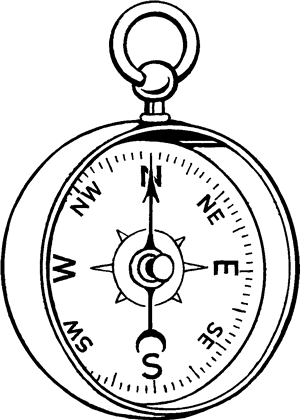
Compass

A compass is an instrument containing a freely suspended magnetic element which displays the direction of the horizontal component of the Earth’s magnetic field at the point of observation.
Magnetic Compass
The magnetic compass is an old Chinese invention, probably first made in China during the Qin dynasty (221-206 B.C.). Chinese fortune tellers used lodestones (a mineral composed of an iron oxide which aligns itself in a north-south direction) to construct their fortune telling boards.
Eventually someone noticed that the lodestones were better at pointing out real directions, leading to the first compasses. They designed the compass on a square slab which had markings for the cardinal points and the constellations. The pointing needle was a lodestone spoon-shaped device, with a handle that would always point south.
Magnetized Needles
Magnetized needles used as direction pointers instead of the spoon-shaped lodestones appeared in the 8th century AD, again in China, and between 850 and 1050 they seem to have become common as navigational devices on ships.
Compass as a Navigational Aid
The first person recorded to have used the compass as a navigational aid was Zheng He (1371-1435), from the Yunnan province in China, who made seven ocean voyages between 1405 and 1433.
Ferrites or magnetic oxides are stones that attract iron and other metals. These are natural magnets and are not inventions. However, the machines that we make with magnets are inventions.
Ferrites were first discovered thousands of year ago. Large deposits were found in the district of Magnesia in Asia Minor, giving the mineral’s name of magnetite (Fe3O4).
Magnetite was nicknamed lodestone and used by early navigators to locate the magnetic North Pole. William Gilbert published De Magnete, a paper on magnetism in 1600, about the use and properties of Magnetite. In 1819, Hans Christian Oersted reported that when an electric current in a wire was applied to a magnetic compass needle, the magnet was affected – this is called electromagnetism.
In 1825, British inventor William Sturgeon (1783-1850) exhibited a device that laid the foundations for large-scale electronic communications: the electromagnet. Sturgeon displayed its power by lifting nine pounds with a seven-ounce piece of iron wrapped with wires through which the current of a single cell battery was sent.
Cow Magnets
U.S. patent # 3,005,458 is the first patent issued for a cow magnet issued to Louis Paul Longo, the inventor of the Magnetrol Magnet, for prevention of hardware disease in cows

Strange Facts

It takes 17 muscles to smile & 43 to frown
OSTRICH eats pebbles to help digestion by grinding up the ingested food
When you sneeze air rushes out your nose at a rate of 100 miles per hour
The cosmos contains approximately 50,000,000,000 galaxies
Owl is the only bird, which can rotate its head to 270 degrees
Buddha delivered his first sermon at Sarnath
Hummingbirds are the only animal that can also fly backwards
A 15 letter word that can be spelled without repeating a letter is uncopyrightable
8.7 million of United State residents who were born in Asia.
KIWIS are the only birds, which hunt by sense of smell
Dolphins sleep with one eye open
Bats always turn left when exiting a cave
Cat’s urine glows under a black light
Bird Feeding: Do not feed avocado as it is toxic to birds
Vitamin K is necessary for clotting of blood
A Blue Whale can eat as much as 3 tones of food everyday, but at the same time can live without food for 6 months